11Nov

Relaxation Techniques: The Top 4 Types

If you’re reading this, you may be feeling the effects of stress and are seeking some relief! This blog will briefly describe the way our bodies – and our gut – respond to stress, and give you some tools to improve your resilience and overall wellbeing. We will discuss the best types of relaxation techniques for stress reduction.

Humans are not well adapted to the modern world 

stressed woman juggling responsibilities

Every day, we encounter minor mental stressors that our ancestors didn’t have to deal with. They had to deal with the physical threat of fighting predators, while we have to deal with things like long work-weeks, financial worries, adapting to life during a pandemic… These things don’t compare when it comes to life and death, but unfortunately for us, our bodies react the same way to both types of situations.

Our bodies have an automatic response to stress, which our brains perceive as a psychological threat. The brain triggers a cascade of events within the body called the stress response, which way back in the day was meant to ensure our survival. Today, the stress response may be triggered multiple times over the course of the day, keeping our cortisol levels high and leaving us in a maladaptive, sympathetic nervous system state.

The stress that so many of us feel on a daily basis can actually be both physically and mentally harmful. Stress has a HUGE impact on digestion and gut health, and luckily for us, there are steps we can take in order to take back control over our gut health in the midst of a stressful life.

The relaxation techniques listed below can be practiced regularly to give you better control over your reactions to stress. But first, let’s discuss the impact stress has on your gut health.

How does stress impact the gut?

For digestion to function normally, we must be in a relaxed, unstressed state where the parasympathetic branch of the autonomic nervous system is in control. Whenever we experience stress, the automatic stress response activates the opposing branch of the autonomic nervous system – the sympathetic branch.

The sympathetic branch inhibits digestive functions, because they are not essential for immediate survival. This can lead to many digestive problems, especially when stress becomes a recurrent aspect of your daily life – when stress becomes chronic.

So what impact does stress have on the gut? Some symptoms (that you may be quite familiar with) that are commonly experienced due to stress can include diarrhea, constipation, nausea, indigestion, abdominal pain, and heartburn.
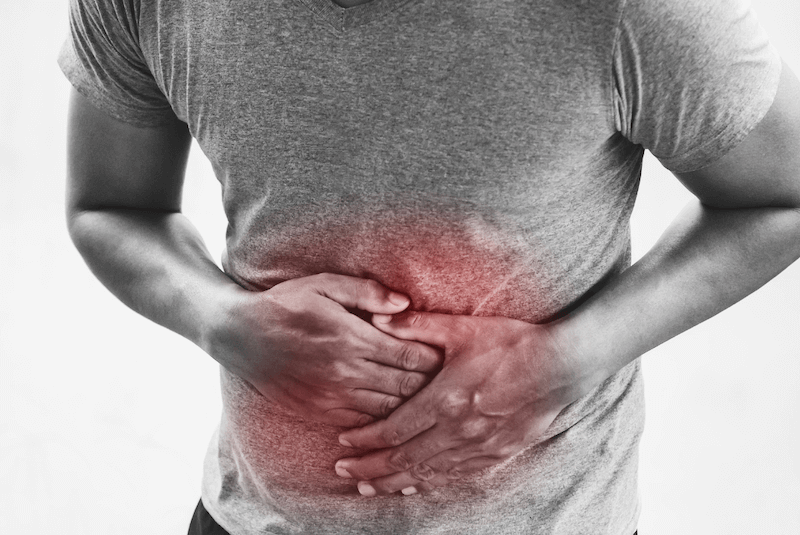
man in black and white grabbing stomach highlighted in red

Enough bad news… let’s get to the good news! Reducing the stress in our lives is not only possible; it is relatively simple to do. Here are some stress reduction and relaxation techniques that you can add to your daily life today!

Relaxation Technique #1: Vagus Nerve Exercises

The vagus nerve is part of the parasympathetic autonomic nervous system – the branch that dominates only when we’re relaxed. This branch is nicknamed the “rest and digest” branch because digestive processes can only function under a relaxed, parasympathetic state.

Your vagus nerve is connected to every organ in your torso except the adrenal glands, which pump out the stress hormones when you are stressed.

The vagus nerve has many impacts on digestive health, and stimulating this nerve is important for improving resilience in the face of stress. So how do we stimulate this nerve to make it function better?

The vagus nerve runs through the muscles in the back of your throat. Vibrations on these muscles can activate the nerve, which over time can help you bounce back from stress more easily.

Here are a couple simple things you can do to stimulate the nerve and improve your vagal tone:

  1. Gargle warm salt water (until your eyes start watering!)
  2. Sing at the top of your lungs! Or hum loudly.
  3. Use cold water for 1 minute at the end of your showers
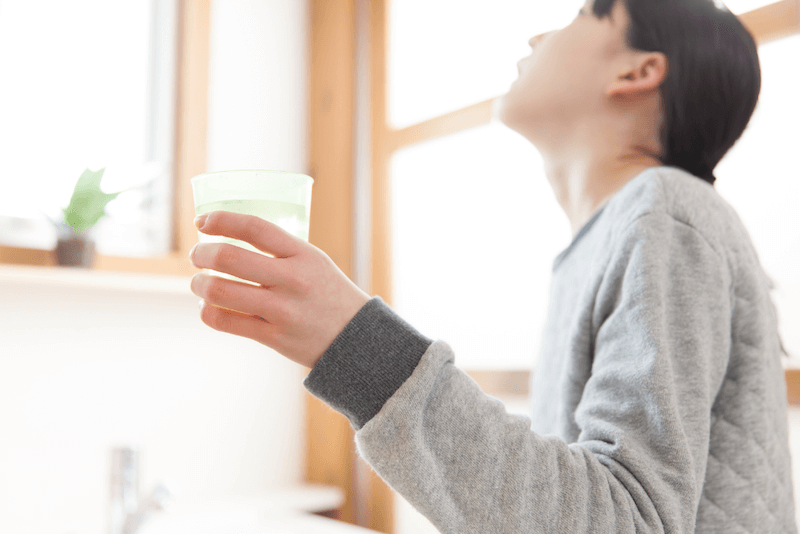
woman gargling water in her bathroom

Luckily, practicing vagus nerve stimulation at home can be so simple! Both of these techniques are easy to do and can be added to your daily regimen immediately, so why not try them out today?

Relaxation Technique #2: Practice Mindfulness

Mindfulness involves simply being present in the moment and paying attention to any bodily sensations. We are predisposed to have our minds wander since we are constantly stimulated in our daily lives. Mindfulness techniques center you to notice your current physical and mental state without judgment. The continued practice of bringing attention to the present moment and how you are connecting with your surroundings is clinically shown to reduce stress and negative mental states.

woman meditating at her desk in front of her laptop

A common mindfulness method is to complete a body scan. To do this, you can be lying down, sitting, or standing. Just close your eyes, breathe slowly, and focus on how your body feels starting from your feet upward, or from your head downward. Focus on how your clothes feel on your body, how certain body parts feel touching each other, and any pressure felt from the ground or the chair. Doing this even just a couple times can help reduce stress and induce a feeling of peace.

Relaxation Technique #3: Yoga Nidra

Yoga nidra, also known as “Yogic Sleep,” is a form of pre-bedtime guided meditation that puts you in a very relaxed state. For most people, this form of meditation is much easier to accomplish than sitting still and trying to “clear your mind.” Practicing yoga nidra over time can lead to benefits such as better sleep, reduced stress, and improved wellbeing.

Yoga nidra involves lying down on a yoga mat (or even your mattress), setting a sankalpa (intention), and simply following what the guided meditation says. Some practices are 5 minutes, others can be an hour or longer. There are many audio guides of varying lengths available online that can easily be followed at home, so this practice is accessible to everyone!
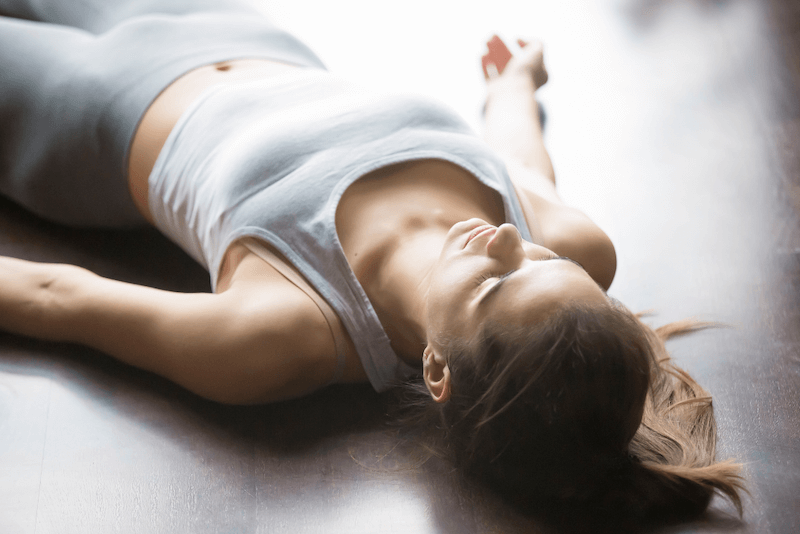
woman laying on the floor yoga nidra

Yoga nidra is an easy way to reduce stress, relieve tension and pain, and connect with yourself on a deeper level. Practicing yoga nidra right before you go to sleep can clear the mind and allow yourself to tap into your subconscious self to reach your goals and intentions.

Relaxation Technique #4: Deep Breathing Exercises

One of the best relaxation techniques involves something that we usually do without any thought. Breathing is essential to human life, and is key in both the mindfulness and in yoga nidra practices mentioned above.

The diaphragm is the key muscle that is used in relaxed breathing states. However, many people breathe using their accessory respiratory muscles rather than the diaphragm.

To test whether you’re prone to dysfunctional breathing, place one hand on your chest and the other on your belly. Take a few deep breaths in, and pay attention to which hand is moving. Your belly should be the area that expands when you inhale. If your chest is expanding more than your belly, this is a sign that you might be in a sympathetic state, under stress.

Slow, deep breathing using your diaphragm improves efficiency within the lungs.  Clinical studies also show that deep breathing plays a huge role in our cardiovascular health and helps to decrease blood pressure. It can also promote higher heart rate variability (HRV), which is a sign of high vagal tone.

Studies suggest that practicing deep breathing exercises regularly for 3 months or longer can shift your autonomic nervous system to parasympathetic dominance – this means that deep breathing can modulate your stress response so that you are more resilient in the face of stress!
the words just breathe scratched into the sand on the beach at sunset

Deep breathing exercises have been practiced for centuries, especially in Eastern cultures. Western cultures are just now realizing the advantages of a more holistic approach to wellness, even though many practices have been around for hundreds of years. In yoga, breathing is called “pranayama.” One variation of pranayama is alternate nostril breathing.

How to do Alternate Nostril Breathing:

  • Sit in an upright, relaxed position and close your eyes. Place one hand with your palm facing upwards on top of your knee.
  • With your other hand, raise your pointer and middle fingers and lightly place them in between your eyebrows. Your ring and pinky fingers should cover one nostril, and your thumb covers the other nostril. Do not exert any hard pressure to your nose or forehead.
  • Exhale through your right nostril while holding the left nostril shut.
  • Inhale through your right nostril, then shut the right nostril and release the left nostril.
  • Exhale through the left nostril, while keeping the right nostril closed.
  • Inhale through the left nostril, then close the left nostril and exhale through the right nostril. This step completes one cycle of alternate nostril breathing.
  • Continue these steps for as long as needed to relax the mind.
  • Always inhale through the nostril you just exhaled through.
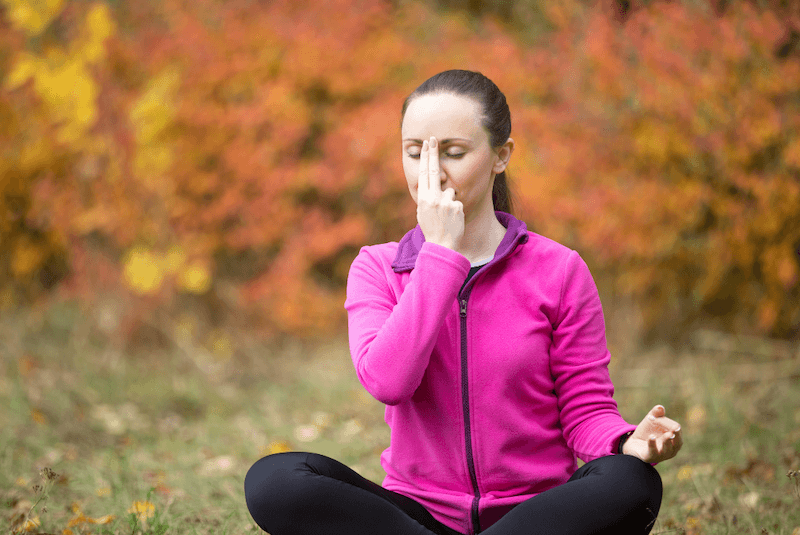
woman sitting outside in autumn practicing alternate nostril breathing

Another deep breathing exercise that can be used to calm your nerves is called 4×4 breathing (aka square/box breathing).

How to do 4×4 Breathing:

  • Sit or lie down in a comfortable, relaxed position and close your eyes. Release any tension from your body.
  • Inhale through your nose for 4 seconds
  • Hold your breath for 4 seconds.
  • Exhale through your mouth for 4 seconds.
  • Hold your breath for 4 seconds.
  • Repeat this cycle as many times as you want over the course of a few minutes until you feel a sense of calm.


Since stress negatively impacts our health, it is important for us to take back control in whatever ways we can. As you can see, none of these relaxation techniques are very difficult, so it is easy to get started today! Pick whichever relaxation technique works best for you, or combine multiple techniques and you may begin to feel less stressed within a short period of time.

woman singing into her shower head in the bathtub

Still feeling stressed over your gut health?

Schedule your free 15-minute strategy call today to help you get to the root cause of the problem, so you can start living your best life!
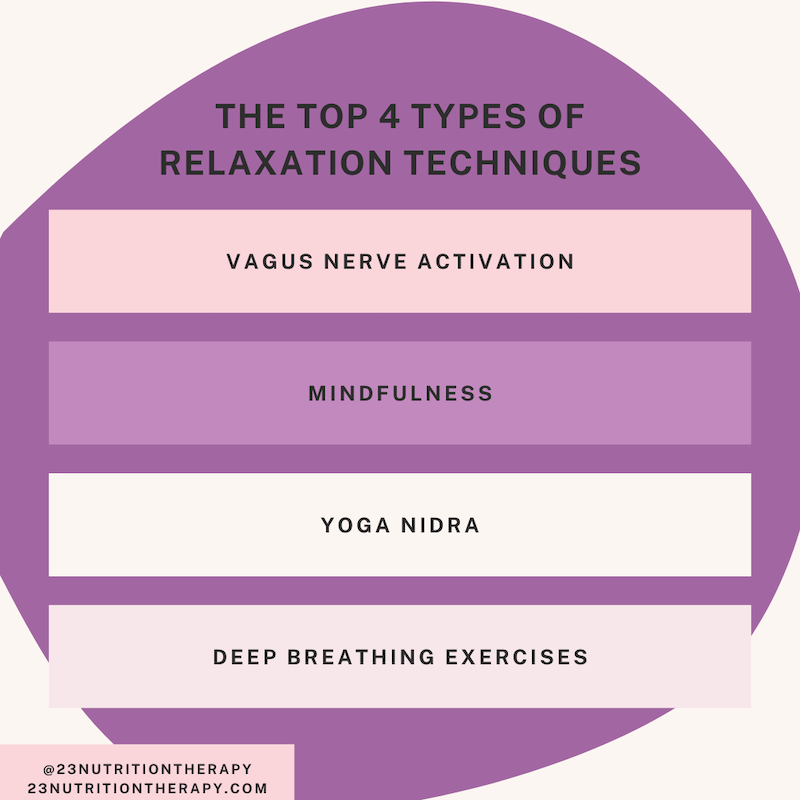
the top 4 types of relaxation techniques


Sources:

https://breathe.ersjournals.com/content/13/4/298

https://www.sciencedirect.com/science/article/abs/pii/S1566070201002673

https://search.proquest.com/openview/9b98ccfa3b77e8dc6667b20e1ca0f96c/1?pq-origsite=gscholar&cbl=37533

https://www.sciencedirect.com/topics/medicine-and-dentistry/heart-rate-variability

https://www.ncbi.nlm.nih.gov/pmc/articles/PMC6134749/

12Oct

HPA Axis Dysfunction and Chronic Stress

Evolution has hard-wired our bodies to react to threats in a very specific way. The stress response is a survival mechanism that primes our bodies to be able to fight or flee when we are faced with a threatening and stressful situation, such as when you see a lion watching you from a distance.

Nowadays, we don’t get into positions that require us to fight off predators frequently, but we do experience many other situations that stress us out, triggering the hard-wired, automatic stress response.

The modern lifestyle in today’s world throws so many hassles at us that our ancestors never had to experience. Work, worrying about finances and paying bills, sitting in bumper-to-bumper traffic, and navigating life during a pandemic… Consequently, your body treats these non-life-threatening stresses the same way as it would a threat to your life.

When you are in a state of constant stress, this evolutionary survival response is triggered repeatedly, and over time becomes extremely detrimental to your overall health.

Today, the stress response kicks in more frequently than ever and can lead to many different health issues. So what exactly happens in the body when we encounter a stressful situation?

The Hypothalamic Pituitary Adrenal Axis – Explaining the stress response

The stress response consists of a series of physiological events in the body that proceeds like a domino effect almost instantaneously. The sequence of events happen before the brain’s visual centers can even fully process the event, which is why it is sometimes possible to react to a dangerous situation before you even realize what is happening.

When you experience or perceive a threat, physical or psychological, this information is sent directly to the amygdala – the emotional processing center of the brain. Your amygdala concludes that the situation is a threat, and then signals the hypothalamus – the brain’s command center – to sound off both neural and hormonal (AKA neuroendocrine) alarm signals to the rest of the body.

The hypothalamus starts by activating the sympathetic nervous system, which triggers the fight or flight response so your body can respond to the perceived threat. This happens through the sympathetic stimulation of the medulla of the adrenal glands, which releases epinephrine (AKA adrenaline) into the bloodstream.


View this post on Instagram


A post shared by Functional Medicine Dietitian (@23nutritiontherapy) on

Epinephrine/Adrenaline Rush

This surge of epinephrine causes your heart to beat faster and your blood pressure to increase, in order to push blood to your muscles so you can better fight or escape the threat.

Stored glucose and fatty acids are released into the bloodstream to provide energy throughout the body. Your breathing rate increases in order to bring more oxygen into the body, which is sent to your muscles and to the brain to increase your level of alertness.

Meanwhile, the hypothalamus also sends off a second alarm signal to keep the sympathetic nervous system activated so that you’re able to continue to face the threat. This second alarm signal goes through what is called the hypothalamic-pituitary-adrenal (HPA) axis.

HPA Axis and Cortisol, The Stress Hormone

This second alarm signal is a hormone called corticotropin-releasing hormone (CRH), which travels to the anterior pituitary gland where it binds to CRH receptors, triggering the release of adrenocorticotropic hormone (ACTH).

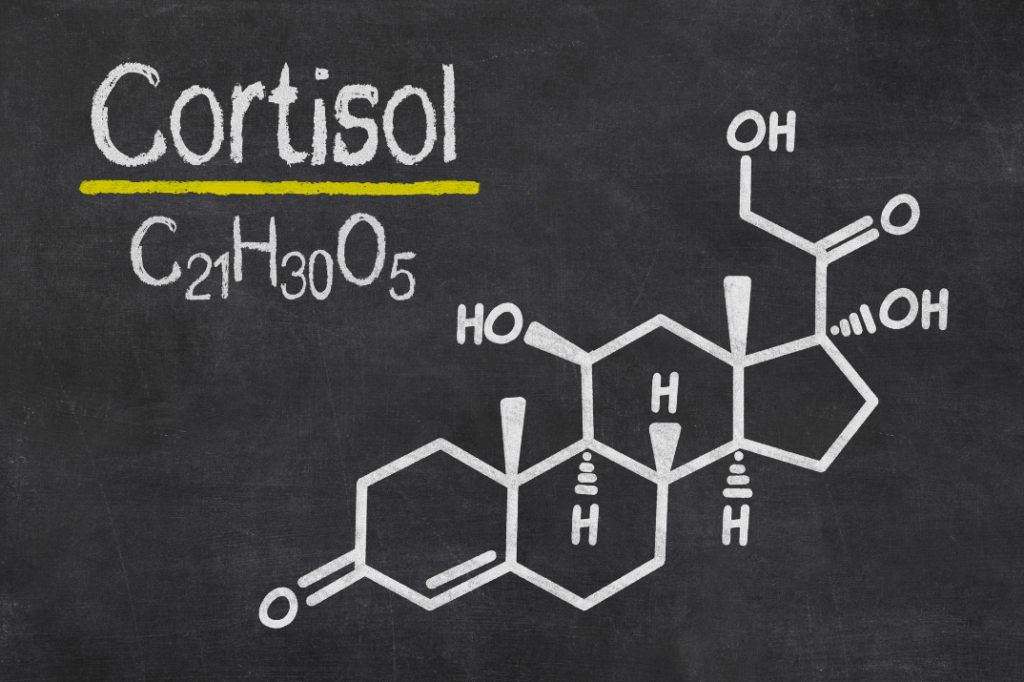
ACTH travels through your bloodstream to reach the adrenal glands, where it binds and triggers the release of cortisol – commonly known as the stress hormone.

chemical structure of cortisol

Cortisol keeps your body on high alert until after the dangerous situation is over with, through mobilizing energy stores and increasing blood sugar levels for a quick energy source to be used throughout the body.

Once cortisol levels start to fall, the parasympathetic nervous system (the rest-digest system) kicks in to diminish the effects of the stress response.

While the stress response is going full steam ahead, nonessential activities (such as digestion) in the body are halted. Blood is shunted away from the digestive system and other non-essential processes, towards the muscles and heart where more oxygen is needed.

Any system that doesn’t immediately serve to address the threat is shut down to conserve energy for the fight or flight response. Our bodies were designed to face stressors automatically and with intensity in order to ensure our survival.

The stress response is supposed to be self-limiting, meaning that once the event is over, the stress hormones should go back to normal levels. The diminishing of the stress hormones allows your heart rate, blood pressure, breathing rate, and blood sugar to also decrease to normal levels.

However, even in the past the dangerous situations that prompted this kind of response didn’t happen continuously throughout the day. Today, many people face constant, daily low (or high) levels of stress that keep the stress response turned on. This leads to HPA axis dysfunction, disrupting normal bodily processes, and over time can contribute to negative health outcomes.

Very stressed out man holding his. head

Sympathetic Dominance – What happens when stress becomes chronic?

Chronic stress triggers the stress response over and over again. Cortisol levels remain high, making it nearly impossible for the parasympathetic nervous system to take over and fulfill its job in certain bodily processes.

When the parasympathetic nervous system is unable to fulfill its duties because you’re spending most of your life using your stress-based sympathetic nervous system – this is called sympathetic dominance.

Chronic Stress, Digestion, and Appetite

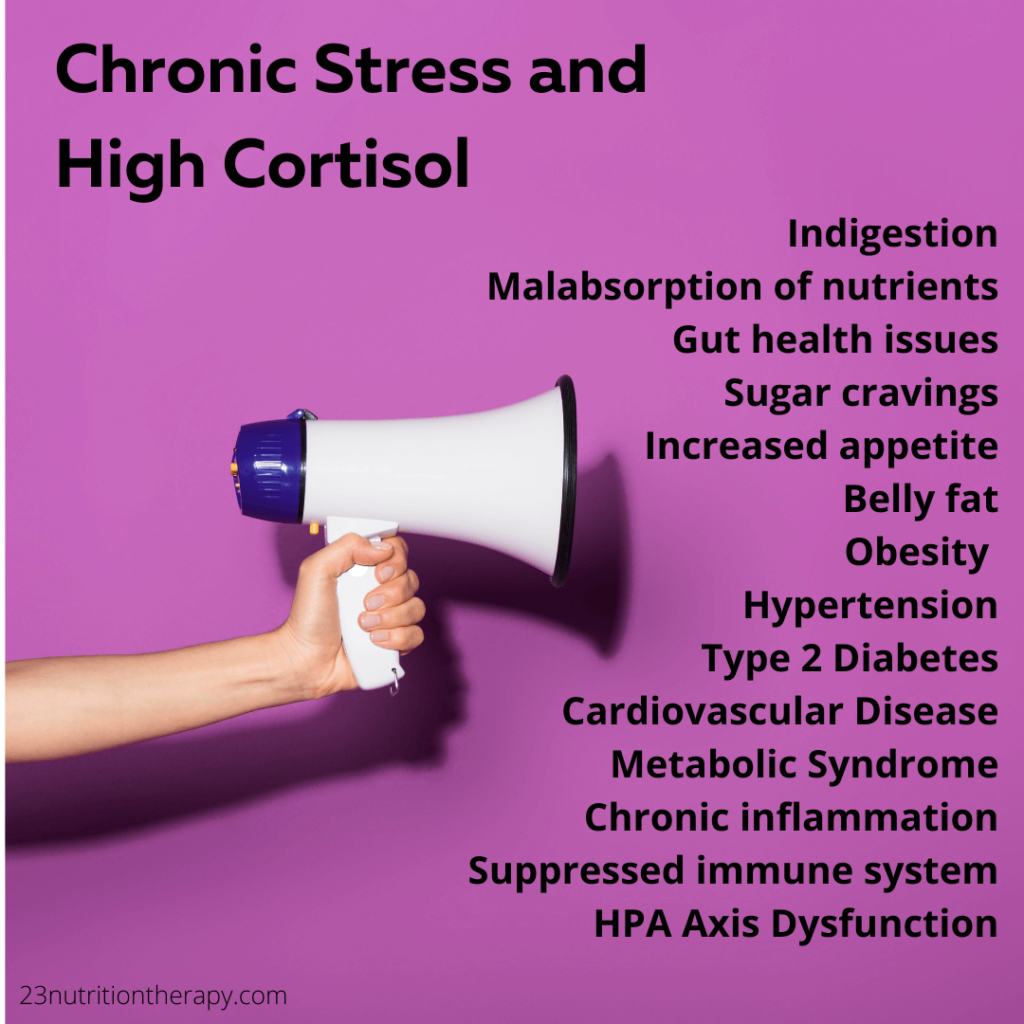
One of the roles that the parasympathetic nervous system is blocked from fulfilling due to sympathetic dominance or HPA axis dysfunction is digestion. So, it makes sense that digestive issues are a common result of chronic stress. Indigestion, IBS, malabsorption of nutrients, and many other gut health issues can be caused by – or exacerbated by – chronic stress.

These high cortisol levels also contribute to increased appetite, especially for sugar and simple carbohydrates, that can lead to overeating and weight gain, and eventually even obesity.  There is a huge connection between cortisol and belly fat.

A common sign of high cortisol levels is higher levels of abdominal visceral fat, which appears as a “pot belly.” High levels of visceral fat are associated with type 2 Diabetes, cardiovascular disease, and metabolic syndrome.

Chronic Stress, Inflammation, and High Blood Pressure

Chronic stress can lead to chronic inflammation, which can also keep cortisol levels elevated. Cortisol suppresses the immune system, making you more susceptible to illness and gastrointestinal issues. This can put you at risk to develop an autoimmune disease.

Another job that cortisol has is to help deliver oxygen to muscles by constricting blood vessels, which increases blood pressure. Chronic high cortisol can lead to chronic high blood pressure. This can damage blood vessels and cause blockages, paving the way for a heart attack.

HPA Axis Dysfunction and Chronic Stress

Other common issues that can arise from the overexposure to stress hormones include anxiety, depression, headaches, sleep problems, and memory issues.

Long-term stress causes HPA axis dysfunction or adrenal dysfunction. This puts you at risk for adrenal fatigue, where your adrenal glands have difficulty keeping up with the body’s constant demands to keep pumping out the hormones needed. This results in many body systems shutting down and you end up feeling completely burned out.

The effects of HPA Axis Dysfunction and chronic high cortisol can include:

  • Indigestion
  • Malabsorption of nutrients
  • Gut health issues
  • Sugar cravings and increased appetite
  • Weight gain (especially around abdomen) and obesity
  • Type 2 Diabetes
  • Cardiovascular Disease
  • Metabolic Syndrome
  • Chronic inflammation
  • Suppressed immune system
  • Hypertension (high blood pressure)
  • HPA Axis Dysfunction, Adrenal Dysfunction/Burnout/Fatigue
Graphic listing signs of chronic stress and high cortisol

Low Stress Resilience – Why do some people have stronger reactions to stress?

You may have realized that some people react more strongly than others to stressful events. We all know someone who we would describe as “high-strung”. There is also the type of person who holds in all of their emotions. Finally, we may envy someone who is strangely calm when they’re under pressure.

But why is this the case? There are a few things that determine your stress resilience (your ability to react better under stress).

Genetics and Epigenetics

How we react under stress has a bit to do with genetics. People that react very strongly may have certain genes “turned on” that amp up their stress response The people who can stay relatively calm may have slightly different genes that better protect them.

Epigenetics (alterations to gene expression) in the form of gene tagging may also have an effect on how we react to stressors. For example, certain chemical compounds, like methyl groups, attached to certain genes can act as a block during gene expression. This makes it more difficult for the gene to be translated into a protein by blocking the gene, potentially altering brain signaling.

Early Life Trauma

Early life trauma also has a huge impact on how we react to stress. These traumatic events occur within the first 20 years of life while the stress systems are still developing.

These traumas can include things that aren’t even a part of your explicit memory, such as our time during infancy. Traumas can include anything that impacts you emotionally: trauma is any experience that elicits a negative emotional reaction.  Early life trauma can lead to epigenetic changes to the stress systems and to the gut-brain connection.

Gut Microbiome

Another part of our physiology that early life trauma can impact is our gut microbiota. In early life, the development of the stress response is influenced by our gut microbiota. Our gut microbiome influences the brain through the metabolites and other products they produce within our digestive tracts. This is a relatively new area of research, and we’re now finding out how the bacteria that live in our gut impact our daily lives.

Three things that can negatively affect stress resilience:

  • Genetics and epigenetics
  • Early life trauma
  • Gut microbiota or dysbiosis (imbalance in gut microbiota)

How to lower cortisol levels naturally – what you can do to tone down your stress response

Finding ways to better manage stress can lead to better health outcomes. Eliminating unnecessary stressors is always a good place to start. But some stressors in life are unavoidable and out of our control. For the stressors you can’t control, practicing stress management and using relaxation techniques are great strategies.

Sleeping well and eating healthy are both key factors that can help keep your stress levels low.

It is also important to take time for hobbies and do the things that you enjoy. This is so important for stress reduction and helps you maintain a sense of overall well being. 

Staying active is another essential way to de-stress. Exercise leads to deeper breathing, which activates the parasympathetic nervous system. Muscles loosen up, relieving tension in the body. Yoga is a great way to increase mental focus while getting your muscles moving and producing a sense of calm.

Relaxation Techniques to Repair HPA Axis Dysfunction

There are quite a few self-soothing relaxation techniques that can be used to dampen your stress responses once they are activated.

These exercises include things like deep breathing, mindfulness, and meditation. These exercises can be done when you are experiencing stress to get your parasympathetic nervous system to kick in.

The exercises can also be done throughout the day in order to train your body to stay more relaxed when stressful events do occur. Practicing relaxation techniques can repair HPA axis dysfunction, making you more resilient in the face of stress.

Woman meditating on hilltop at sunrise

Importance of a Lifestyle Overhaul

If you think you’re experiencing the effects of chronic stress, it is helpful to do a complete lifestyle overhaul to put you in a better position to deal with stress.

This lifestyle overhaul isn’t meant to add more stress to your life. It is best to start by adding just one of the things mentioned above. Find out what works best for you, and then slowly add on more stress-reducing activities or exercises.

Improving your resilience to stress is key to long-term health, and can help to prevent many negative health outcomes. When you’re feeling stressed out by things you cannot control, starting with one simple step can ultimately help you to gain more control over your response to stress.

Ways to lower cortisol naturally to Fix HPA Axis Dysfunction:

  • Yoga
  • Mindfulness
  • Meditation
  • Deep breathing exercises
  • Lifestyle overhaul


Are your gut health issues adding additional stress in your life? Let’s tackle that together!

Schedule a meeting today to get started on the pathway to better gut health. Let me help you can gain control in your life and stress less.

Take this quiz to evaluate your stress resilience

Woman with arms stretched up at sunrise